

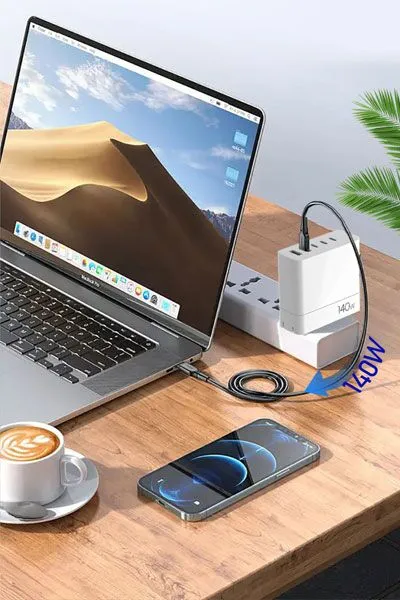
The old laptop brick had a strange talent: it made every bag feel messy before the trip even started. A Gallium Nitride Charger fixes that pain by shrinking the adapter, cutting wasted heat, and letting one USB-C block cover a phone, tablet, earbuds, and many laptops. For Americans who work from airports, coffee shops, college dorms, RVs, and kitchen tables, that change matters more than a spec sheet. You carry less. You free an outlet. You stop treating chargers like a drawer full of leftovers. The shift also fits the way buyers now follow consumer tech news coverage before replacing everyday gear. GaN chargers are not magic, and they do not make every device charge at the same speed. The device, cable, and power standard still set the limit. Still, the better models remove the pain that made charging feel dated: one-purpose blocks, tangled cords, and adapters that ran warm while doing ordinary work. That is why this upgrade feels less like a gadget trend and more like a cleanup of everyday life. The direction is clear: the big black brick is losing its job.
The Brick Problem Was Never Only About Size
A chunky adapter looks like a size problem, but the deeper issue is friction. It steals the second wall outlet. It sags from loose plugs in hotel rooms. It pulls at the cable when your laptop sits on a narrow café table. When a tool causes that many small annoyances, people stop thinking of it as a tool and start treating it as clutter. That is how charging became one of those background problems nobody planned to fix until smaller hardware made the old setup look silly.
Why older adapters felt bigger than their wattage
Traditional silicon-based chargers did their work well for years, but they needed more room to handle heat and conversion losses. That is why a 65W laptop adapter often came with a brick in the middle of the cable and a thick wall lead on one side. The shape was not random. It was a heat and safety compromise.
You noticed the compromise most when you packed for a normal U.S. workday. A MacBook charger, a phone block, a watch puck, and a pair of earbuds could occupy more space than the devices that needed them. A remote worker flying from Dallas to Chicago might carry three adapters because one older brick had one output and one job. At home, the same mess moved into the junk drawer. Nobody meant to collect six wall cubes, but each device arrived with its own little rule.
The counterintuitive part is that size was also a trust signal. Big felt safe. Heavy felt serious. Small adapters used to look cheap, so buyers assumed they were weaker. GaN flipped that feeling by making the smaller object the more capable one, at least when it is well-built and matched to the right cable. That shift took time because buyers had to unlearn a habit formed by years of hot plastic blocks and slow phone chargers.
The outlet fight nobody notices until travel day
The worst charger is not always the slow one. Often, it is the one shaped badly enough to block the outlet next to it. Anyone who has charged a laptop in a packed airport gate knows that social awkwardness: your brick takes two spots, and the person next to you now has none.
A compact laptop charger solves more than bag weight. It changes how you behave around power. You can plug into a power strip without covering nearby sockets. You can charge from a hotel desk outlet without moving the lamp. You can keep one adapter in your backpack instead of building a small power station every morning. That matters for business travelers, but it also matters for students who spend half the day moving between class, library tables, and shared lounges.
This is why the move away from bulk feels faster than many gadget upgrades. It touches daily habits. A faster screen refresh rate is nice. A smaller charger that works in the only free outlet at LaGuardia is useful before you even think about specs. The win is not glamorous. It is the small relief of packing one block and trusting it.
Why Gallium Nitride Charger Design Makes Old Bricks Feel Outdated
The key shift is material behavior. GaN belongs to a class of wide bandgap semiconductors that can help power electronics reach higher power density and efficiency than older designs, which is one reason researchers study it far beyond phone chargers. In plain English, that means a charger can switch power with less waste, manage heat in a smaller shell, and still deliver enough output for modern devices. The science is advanced, but the user benefit is plain: less plastic, less heat, and less guessing about which adapter belongs to which device.
Smaller shells work because heat gets handled earlier
Heat is the hidden tax inside every charger. Wall power has to be converted into the lower-voltage DC power your phone or laptop can accept. Every bit of wasted energy turns into warmth. When the charger wastes less during that conversion, the case does not need as much extra space to keep parts within safe limits.
That is why GaN chargers can pack 65W, 100W, or more into a body that looks closer to a phone cube than an old laptop supply. The best designs still use careful layouts, safety parts, and thermal planning. Small does not mean simple. It means the waste has been reduced enough that the whole system can tighten up. A good design also pays attention to plug weight, internal spacing, and how heat moves through the shell when the charger sits behind a desk for hours.
There is a catch buyers miss. A tiny adapter pushed to its full rating may warm up under load. Warm is not the same as unsafe, but cheap no-name units can cut corners. The smarter move is to buy from a brand that lists power per port, safety markings, and USB-C Power Delivery behavior in clear language. Look for plain claims you can verify, not wild promises printed across a product photo.
USB-C fast charging made one charger feel normal
GaN alone did not retire the old brick. USB-C fast charging gave the smaller charger a common handshake with phones, tablets, handheld gaming systems, and laptops. The USB Implementers Forum says USB Power Delivery can now support higher power over USB Type-C, with the newer PD 3.1 update extending defined levels up to 240W for full-featured cables and connectors.
That matters because a charger is not only an energy source. It is a negotiator. Your laptop asks for one power level, your phone asks for another, and a good multi-port unit divides output without guessing. One port may feed a notebook while another handles a phone at a lower draw. Some phones also use PPS, a mode that adjusts voltage in smaller steps, which can help compatible devices charge in a calmer, better-managed way.
A buyer replacing an old 45W laptop adapter should not shop by wattage alone. Check the laptop’s supported charging profile, the cable’s rating, and how the charger splits power when two or three ports are active. A 100W charger may give the laptop 65W after a phone is plugged in. That is fine, as long as you know it before a long work session. The label on the charger can tell you more than the headline number on the sales page.
What Buyers Should Check Before Replacing Every Adapter
The temptation is to throw every old charger into a box and buy the smallest GaN block on sale. Slow down. A charger sits between wall power and expensive devices. The right pick can make your setup cleaner for years, but the wrong one can leave you with slow charging, cable confusion, or a warm little block that never feels settled. Think of the purchase less like buying a phone case and more like choosing a small appliance that will work near your bed, desk, and backpack.
Match wattage to your real devices, not the biggest number
Most people do not need the highest-watt charger on the shelf. A phone and earbuds can live on a modest adapter. A thin laptop may be happy around 45W or 65W. A larger laptop, portable monitor, or small dock can ask for more, especially under load. The best number is the one that fits your devices with some headroom.
Think about your day, not the box art. A student at Ohio State with a USB-C laptop, iPhone, and headphones may do well with a 65W two-port unit. A freelance video editor who powers a laptop and tablet from the same wall outlet may want 100W or 140W. A family charging four devices in a kitchen may care more about stable multi-port sharing than peak output. The same charger can feel perfect in one house and annoying in another.
This is where a home office power setup guide helps. Power planning sounds dull until your laptop slowly drains while plugged in during a Zoom call. A compact laptop charger should make that problem disappear, not hide it behind a tiny shell. Before buying, write down the devices you charge together, then choose around that scene. Real use beats fantasy use.
Cables decide more than most people expect
The charger gets the attention, but the cable often sets the ceiling. Some USB-C cables handle high wattage. Some are meant for lower power. Some carry fast data. Some are charge-first and data-light. They look the same from across a desk, which is the whole problem.
For USB-C fast charging, use cables with clear power ratings from trusted sellers. If a cable came with an old phone, do not assume it can safely carry laptop-level power. A high-output charger, a weak cable, and a power-hungry laptop make a poor team. The laptop may charge slowly, refuse the connection, or behave in ways that make the charger look guilty. That is how many people end up blaming the adapter when the cable is the weak link.
Labeling helps. Keep one known 100W or 240W-rated cable in your travel pouch. Keep another at the desk. That small habit saves more frustration than buying another adapter. The quiet truth is that the charger upgrade works best when the cable drawer gets cleaned out too. Throw away damaged cords, separate slow spares, and keep your high-power cable where you can find it under pressure.
Where GaN Charging Goes Next in American Homes
The first wave of GaN adoption was about travel. The next wave is about replacing fixed power spots: the kitchen counter, the nightstand, the work desk, the dorm room, and the family room basket where every cable goes to disappear. Once a charger can handle several devices without taking over the outlet, it stops being a gadget and becomes part of the room. That is where the old brick loses the argument. It cannot blend into modern routines on most days. The next buyer will not ask whether a charger is impressive on paper. They will ask whether it keeps the desk clear, charges two devices during dinner, and still fits in the side pocket of a carry-on.
Desks and kitchens are becoming charging zones
A modern desk often has a laptop, phone, tablet, lamp, speaker, and maybe a dock. Older power strips turned that into a knot of bricks. Newer GaN chargers reduce the number of blocks, but the better habit is building zones. One high-output unit at the desk. One smaller unit near the bed. One shared charger in the kitchen for phones and earbuds.
That setup is not about owning fewer chargers at any cost. It is about putting the right charger where the need repeats. A parent in Phoenix may keep a multi-port unit near the kitchen mail tray because that is where school tablets land. A sales rep in Atlanta may leave a 100W unit in the work bag and never remove it. A college freshman may use one desk charger for a laptop, phone, and headphones because dorm outlets are never where you want them.
The non-obvious insight is that shared chargers can reduce family arguments. When every device has its own weak brick, people blame each other for stealing adapters. A labeled multi-port station makes charging boring again. Boring is the goal. The best home tech often fades into the background because it stops asking for attention.
Supply chains may shape the next price drop
GaN chargers feel like a consumer accessory, but gallium sits inside a larger materials story. In April 2026, the U.S. Department of Energy said the country was fully net import reliant on gallium and had not produced the critical mineral domestically since 1987 while announcing projects aimed at domestic recovery.
That does not mean your next charger will become rare tomorrow. It means price, supply, and manufacturing scale still matter. As more chipmakers and accessory brands refine designs, buyers should see better choices at lower prices. Yet the cheapest unit will not always be the smartest buy, especially when it powers a laptop worth far more than the adapter. Saving ten dollars can feel silly if the charger runs hot, shares power poorly, or dies after a few months.
For shoppers, the practical path is simple. Buy enough wattage, buy known safety marks, keep good cables, and avoid mystery listings with strange claims. A best travel tech accessories list can help narrow choices, but your devices should make the final call. The next stage is not only faster charging. It is cleaner power habits that make the devices you already own easier to live with.
Conclusion
The power brick is fading because daily life finally demanded something better. Americans now expect one bag to carry work, entertainment, and backup power without turning into a cable nest. Smaller GaN chargers answer that demand, but the better story is not size alone. It is trust, compatibility, and fewer little failures during a normal day. The Gallium Nitride Charger has become the symbol of that shift because it makes the old adapter feel wasteful without asking users to learn electrical engineering. Still, smart buying matters. Match wattage to your laptop, choose cables with clear ratings, and treat unknown bargain brands with caution. Keep one dependable unit where you work and one where you travel, then stop letting old bricks spread through the house. Recycle aging adapters when local rules allow, and keep only the ones tied to gear that cannot move to USB-C yet. The future of charging will not be one perfect block for every person. It will be a cleaner set of power habits built around fewer, better adapters. Start by replacing the charger you hate carrying most.
Frequently Asked Questions
How does a GaN charger work in simple terms?
It converts wall power into device-safe power with less wasted heat than many older silicon-based designs. That lower waste lets brands build smaller, higher-output adapters. Your device still controls how much power it accepts, so the charger cannot force extra speed.
Is a GaN charger safe for an iPhone or Android phone?
Yes, a quality unit is safe when it supports the right charging standards and comes from a trusted brand. Phones request the power they can handle. The charger responds with an allowed level rather than pushing the maximum wattage all the time.
Can one USB-C charger replace my laptop and phone adapters?
Often, yes. Choose a wattage that meets your laptop’s needs and has enough ports for your phone. Check how the adapter splits power when several ports are used. Some units lower laptop output when another device is added.
Why does my GaN charger get warm while charging?
Warmth is normal during high-output charging because power conversion still creates heat. The concern is excessive heat, odd smells, buzzing, loose plugs, or shutdowns. Stop using any charger that shows those signs, especially around laptops or overnight charging.
What wattage should I buy for a compact laptop charger?
For many thin laptops, 45W to 65W works well. Larger notebooks may need 100W or more. Check the original adapter rating or the laptop maker’s charging guidance. Add headroom when you plan to charge a phone at the same time.
Do I need a special cable for USB-C fast charging?
For higher wattage, yes. Use a cable with a clear power rating that matches the charger and device. A low-rated cable can slow charging or prevent higher power modes. Keep your best cable with your travel charger so you do not have to guess.
Are GaN chargers worth the higher price?
They are worth it when you travel, share outlets, or want one adapter for several devices. The value is less about shaving minutes from every charge and more about replacing bulky gear with a smaller, cleaner setup that you will use every day.
Will bulky power bricks disappear completely?
Not completely. Some high-power devices, older laptops, gaming hardware, and special equipment still use dedicated adapters. For phones, tablets, thin laptops, and many desk setups, though, smaller USB-C chargers are already becoming the normal choice.